Press · May 27, 2026
NanoHydra Pro at CES 2026: How AI-Assisted Misting Redefines K-Beauty Hybrid Skincare
Marie Claire named NanoHydra Pro one of the best beauty devices at CES 2026. Here's why particle size, dual pumps and rhythmic misting are the story.
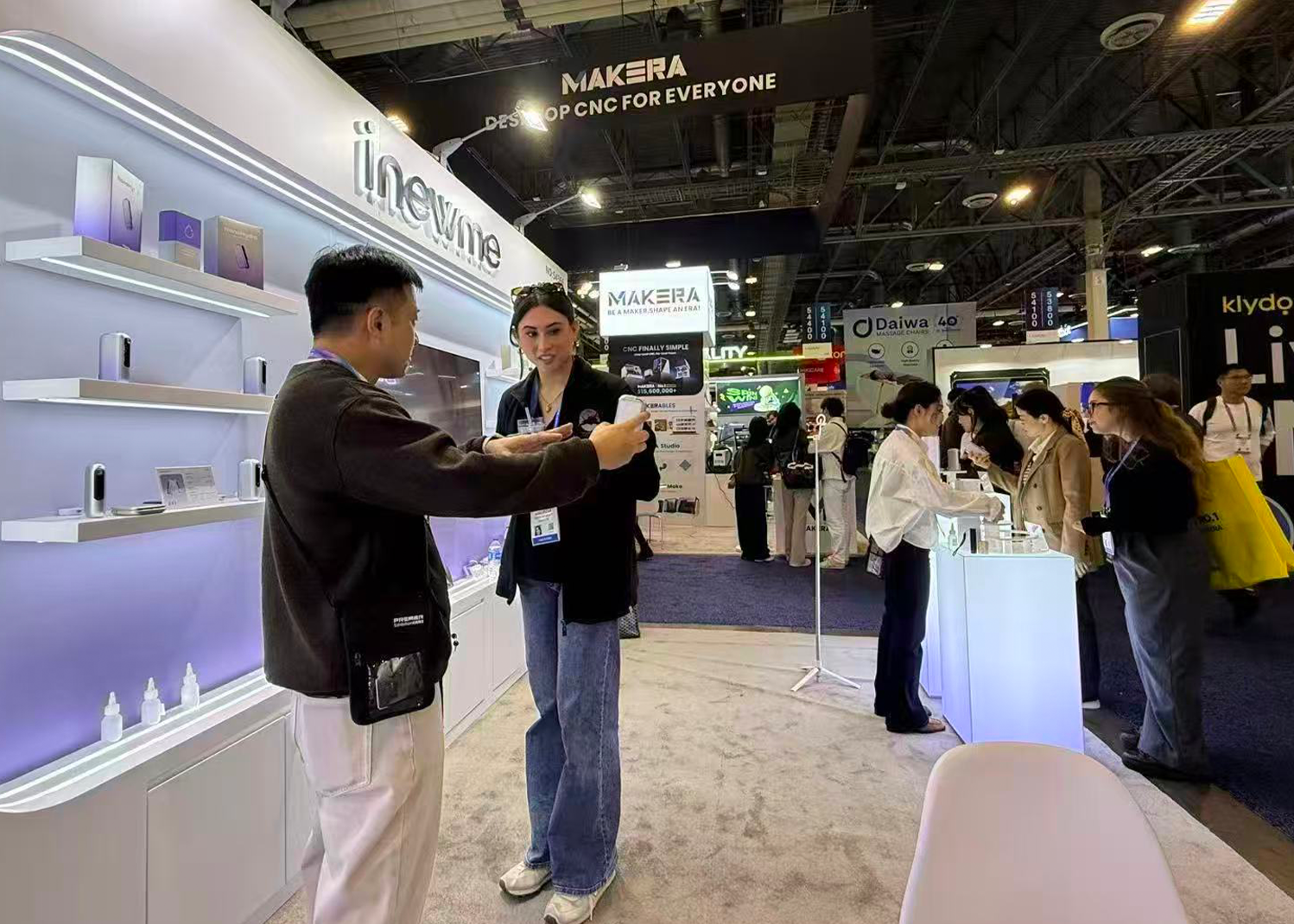
When Marie Claire's beauty editors covered CES 2026, they were looking for devices that solve real skin problems, not gadgets that photograph well in a press kit. Their year-end roundup of the best new beauty technology landed on a small handful of products. Among them: NanoHydra Pro, by the Taiwanese beauty-tech brand inewme.
For us, the mention is more than press. It's confirmation that a quiet category — at-home AI-assisted hybrid skincare devices — has crossed into mainstream beauty consciousness. And it puts a technical decision we made years ago, misting at 10 to 30 microns, right at the center of where K-beauty is heading next.
This piece walks through why CES 2026 mattered for beauty, what NanoHydra Pro actually does, and how the hybrid skincare trend (skincare + tool + app) is changing the daily routine.
What Marie Claire Reported
In its CES 2026 beauty-tech roundup, Marie Claire highlighted NanoHydra Pro as an AI-assisted device that lets users turn their existing serums, ampoules, and essences into a sprayable mist. The publication called out three things specifically:
- A dual-pump system that breaks product down to 10–30 µm particles, for better penetration and less surface evaporation.
- A digital screen that guides spray duration.
- A feature they referred to as "rhythmic misting": five modes that combine hydration with a micro-massage effect.
You can read the full Marie Claire CES 2026 piece here. What it confirms is something we've believed since the first NanoHydra prototype: the future of skincare is not another bottle. It's the interface between your products and your skin.
Why Particle Size Is the Whole Story
Most spray bottles, including premium ones, atomize liquid at roughly 100 to 300 microns. That number doesn't mean much on its own, so here's the practical implication. At that particle size, a meaningful percentage of your serum sits on the surface, evaporates, or beads off entirely. The active ingredients you paid for never reach the lower layers of the stratum corneum, where they actually do their job.
10 to 30 microns is roughly an order of magnitude smaller. At that size, the mist behaves differently:
- It hovers in a fine cloud long enough for skin to "catch" it.
- Surface tension drops, so absorption begins before evaporation does.
- Coverage is even, with no streaking and no soaked patches.
Internal lab tests on NanoHydra Pro indicate 2.6× more effective hydration delivery versus a standard spray bottle. That's the difference between using half your serum and using all of it. Put differently: one bottle of toner ends up behaving like two.
Particle size is the engineering detail that turns "spray something on your face" into a real delivery mechanism. CES audiences notice this. So do dermatologists.
Inside the Dual-Pump System
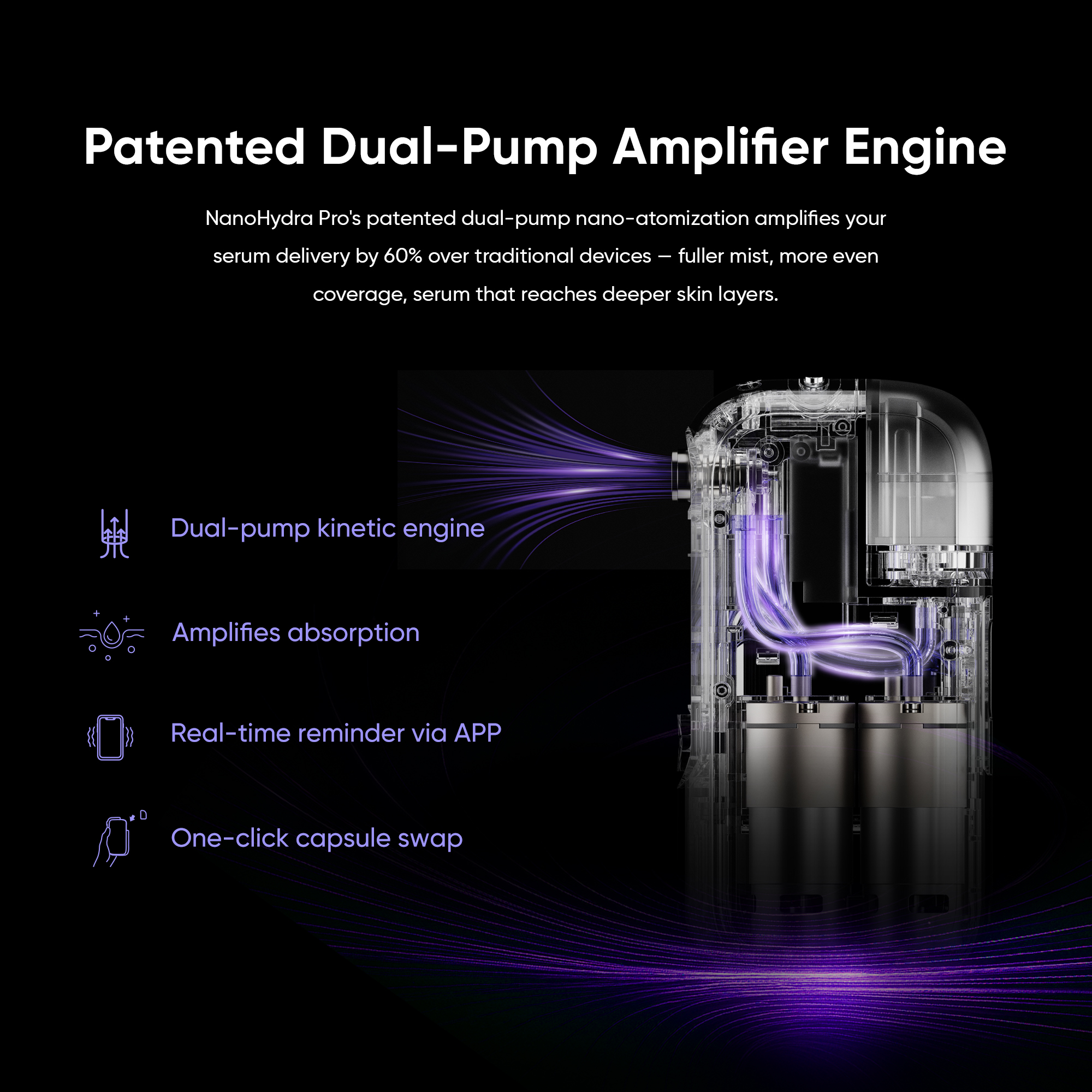
A single-pump atomizer can only do so much. To consistently hit the 10–30 µm window across viscosities ranging from a thin essence to a thicker serum, you need two synchronized pressure systems working against each other. That's what the dual-pump architecture does.
The AI layer sits on top. Sensors inside the device assess the viscosity of whatever you loaded into the HydraCapsule and adjust pump pressure on the fly. You don't have to tell NanoHydra Pro "this is a hyaluronic acid serum" versus "this is a niacinamide essence." It figures it out.
Two refillable HydraCapsules ship with the device. You can use whatever you already have on your shelf: your existing K-beauty routine, your dermatologist-recommended treatment, or your favorite niche serum. The device is product-agnostic, which matters because it means NanoHydra Pro doesn't lock you into a proprietary refill economy.
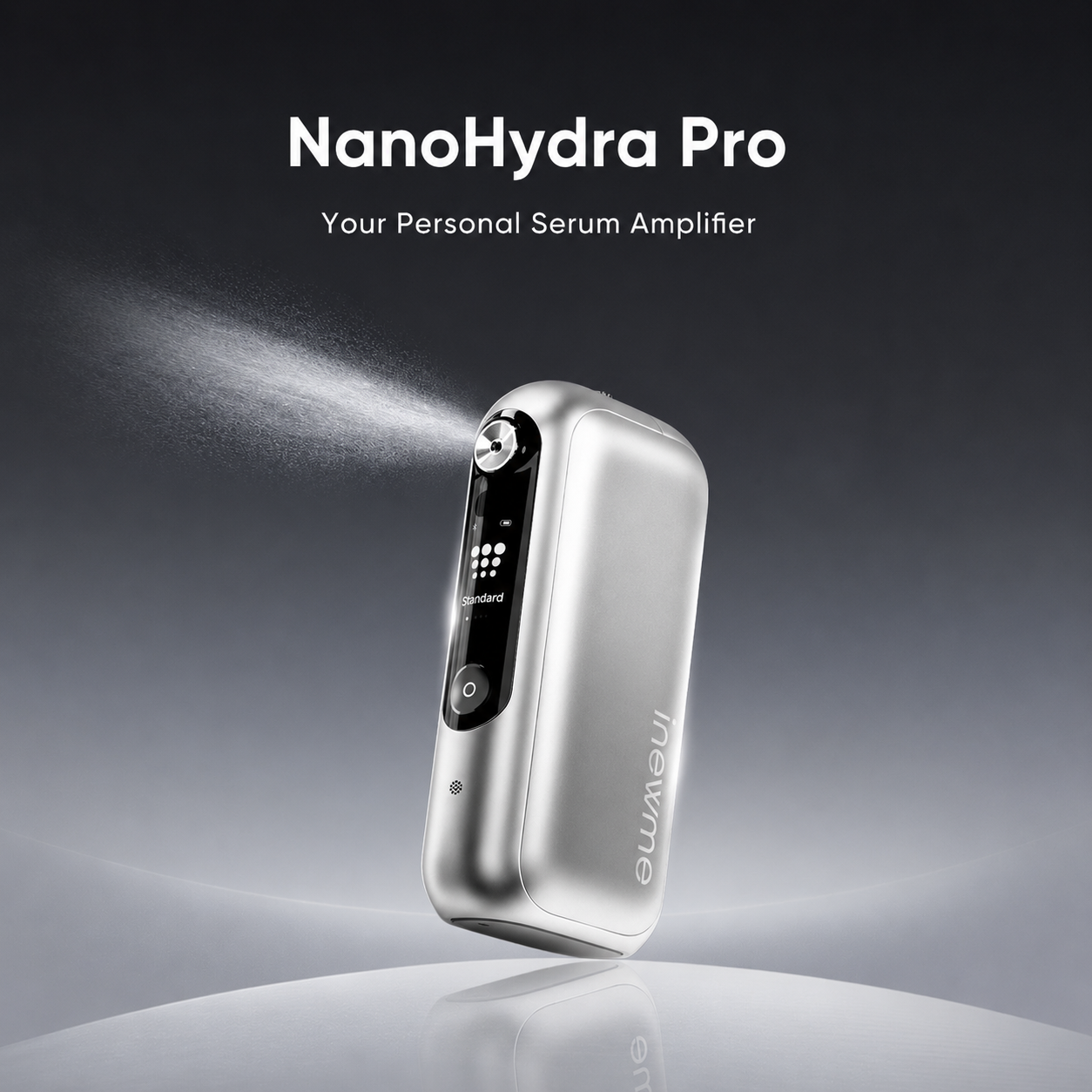
And then there's the form factor. The unit is smaller than an iPhone 16 at 117 mm × 62 mm and around 200 g. It travels. You can keep one in a handbag, a desk drawer, or a gym bag. Hydration moves with you, instead of being tied to the bathroom counter.
"Rhythmic Misting": Why Five Modes Matter
A continuous mist sounds simple, but it's not actually how skin absorbs best. Skin responds to patterned stimulus. That's the principle behind sheet masks held in place for fifteen minutes, gua sha rituals, and the gentle tap-tap-tap motion taught in every K-beauty tutorial.
NanoHydra Pro's five rhythmic misting modes encode that idea. Each pattern alternates burst length and rest interval differently: short and frequent for thirsty skin, longer pauses for sensitive skin, a sustained gentle mode for nighttime, and so on. The cumulative effect is closer to a micro-massage than a spritz.
That's part of why CES editors paid attention. The device isn't asking you to replace your routine. It's asking you to slow down inside it.
The Hybrid Skincare Moment in K-Beauty
If you've been reading the trend reports from Future Market Insights, Beauty Independent, or The Industry Beauty, you've seen the same phrase showing up again and again: hybrid skincare. The definition is settling around three layers stacked together:
- A formulation like a serum, essence, ampoule, or treatment.
- A tool, the device that delivers, stimulates, or measures.
- An app, the layer that personalizes, tracks, and reminds.
Korean conglomerates Amorepacific and APR have been building toward this for years. Amorepacific's recent Electronic Skin Platform launch is one signal. APR's AGE-R companion app, which tracks mode, shot count, and LED color, is another. The trend forecast from The Industry Beauty's 2026 K-Beauty panel was unambiguous: device and app integration is becoming the default, not the differentiator.
NanoHydra Pro slots into that exact moment. The companion app reads ambient humidity through your phone's environmental data and prompts hydration when your environment changes: boarding a plane, walking into a heated office, hitting a dry hotel room in winter. That's hybrid skincare working as intended. Not a dashboard you have to check, but a quiet assistant that knows when to ping you.
How NanoHydra Pro Fits Into the Bigger 2026 Picture
CES 2026 itself was a watershed for what Skinobs Cosmetics Testing News called the dawn of precision beauty: devices, sensors, and software converging into routines that look more like wellness protocols than morning splash-and-go.
A few examples from the same show floor underscore the direction:
- LG Household & Health Care's Hyper Rejuvenating Eye Patch, which uses negative-pressure patch tech and AI skin diagnosis (CES 2026 Innovation Award).
- Kolmar Korea's AI Scar Beauty Device, a 12-class scar diagnostic with custom formulation (CES Innovation double-award winner).
- Multiple wearables that combine LED, microcurrent, and radiofrequency into single multimodal sessions.
What ties these together is a thesis: single-modality skincare is over. The 2026 customer wants devices that diagnose, adapt, and integrate.
NanoHydra Pro is on that thesis. So is our roadmap.
How NanoHydra Pro Compares to Other Mist-Based Devices
A reasonable question to ask: is misting itself the differentiator, or is it the specific approach?
Mist-based delivery in skincare is not new. Vaporizers and nano-misting tools have existed for years. What is new is closed-loop AI managing the misting in real time. Most legacy mist tools are essentially fancy spray bottles with a fan. They don't measure viscosity, they don't modulate pressure, and they don't adjust based on your skin or environment.
Recent product launches in the PDRN (polynucleotide) category, including Anua's PDRN 100 Hyaluronic Acid Hydrating Capsule Mist debuted in New York in early 2026, confirm that mist as a delivery vehicle is a serious category, not a gimmick. But formulation alone is one half of the story. Particle size, modulation, and reminder cadence are the other half. NanoHydra Pro is built around the second half.
That distinction matters most for people already paying for premium serums. If your bottle of treatment essence costs $80, $200, or $400, you are throwing significant money into the air every time you spritz from a standard atomizer. NanoHydra Pro is the case for delivery economics, not just delivery aesthetics.
Who NanoHydra Pro Is For
We get asked this constantly. Here's the honest answer.
- People who already invest in serums ($60+ per bottle) and want every drop to count.
- Travelers and digital nomads who live in changing climates and need hydration that follows them.
- K-beauty routine builders with five-to-ten-step regimens that can be re-thought around delivery quality rather than product count.
- People with reactive or barrier-compromised skin who can't tolerate occlusive layering and need lightweight delivery that still penetrates.
If you're skeptical of devices in general, and you should be, the easiest mental model is this. NanoHydra Pro is not a treatment. It's an amplifier for the treatment you already chose.
How to Use NanoHydra Pro with Your Existing Routine
The simplest workflow looks like this:
- Cleanse and tone as usual.
- Load a HydraCapsule with your favorite hydrating serum, essence, or ampoule. Two HydraCapsules mean you can dedicate one to AM and one to PM.
- Pick a rhythmic mode: gentle for sensitive skin, sustained for dry weather, energizing for morning routines.
- Mist for the on-screen recommended duration (about 15 seconds).
- Follow with your moisturizer and SPF. NanoHydra Pro does not replace your barrier or sun-protection step.
For evening, many users also do a second fascia-relaxing pass with one of the slower modes, using the micro-massage effect to wind down the face after a screen-heavy day. That step is closer to a wellness ritual than a skincare protocol, and it's one of the reasons NanoHydra Pro gets adopted as a nightly habit rather than an occasional treatment.
Why the Press Window Matters
Beauty buyers in 2026 are smarter, more skeptical, and more ingredient-literate than at any point in the category's history. Trust is no longer built on celebrity endorsement. It's built on independent press coverage, peer-to-peer reviews, and demonstrated science.
A Marie Claire mention at CES 2026 is one piece of that puzzle. So is the openPR coverage of the NanoHydra Pro Kickstarter campaign, the Globe and Mail syndicated coverage, and the recent Gadgeteer hands-on writeup.
What they all converge on: the technology works, the form factor travels, and the AI is doing real work, not branding-speak. That's rare in beauty tech, and it's what makes this press window worth paying attention to.
Shop NanoHydra Pro
If you're ready to try the device that Marie Claire spotlighted at CES 2026, the current product line lives at:
- NanoHydra Pro — Silver is the consumer-facing edition of the AI-assisted skin hydrator.
- Capsule Refill Kit holds the nano-infusion capsules designed for the device.
- Aura Mirror Plus is our AI skin-diagnosis mirror, which pairs naturally with NanoHydra Pro's hydration workflow.
The category will keep moving. Particle sizes will keep shrinking. App layers will get smarter. But the underlying insight — that how you deliver skincare matters as much as what you deliver — is the one that CES 2026 just made official.
We're proud Marie Claire noticed.
Citation
Marie Claire. "I Saw the Best New Beauty Technology and Devices at CES 2026 — Here's What to Know." 2026. marieclaire.com